


More Data, Better Data — What Actually Improves a Ground Risk Assessment

More data doesn't automatically make an assessment better — it depends on what the extra data is actually doing. A few different things get lumped under "more data," and they're not all the same kind of improvement. Coverage is the obvious one. No single public dataset covers everything a site assessment needs — flood risk,


By |2026-09-23T08:27:08+00:00September 22nd, 2026|Design, Featured, Geoscience, Geoscreen, News, Technology, Uncategorized|Comments Off on More Data, Better Data — What Actually Improves a Ground Risk Assessment

GeoScreen Now Separately Rates Compressible Ground and Shrink-Swell Risk on the Same Clay

Compressible ground and shrink-swell clay are two different ways the same clay can cause problems for a foundation — one's settlement under load, the other's volume change with moisture content. They're separate failure mechanisms, and until recently GeoScreen rated them from different evidence: shrink-swell from the bedrock beneath a site, compressible ground only from soft

By |2026-09-22T18:43:11+00:00September 16th, 2026|Design, Featured, Geoscience, Geoscreen, News, Technology|Comments Off on GeoScreen Now Separately Rates Compressible Ground and Shrink-Swell Risk on the Same Clay

How We Test Every GeoScreen Report Before It Ships

Every rating GeoScreen produces comes from an explicit rule, not a guess. That's the whole idea the product's built on, so it's worth actually explaining what sits behind that claim rather than just stating it and moving on. Before a report reaches anyone, it goes through two checks. One is rule-based and checks the output

By |2026-09-02T12:30:24+00:00September 2nd, 2026|Design, Featured, Geoscience, Geoscreen, News, Technology, Uncategorized|Comments Off on How We Test Every GeoScreen Report Before It Ships

The gaps GeoScreen was built to fill.

When we were developing GeoScreen, we weren't trying to replace the traditional consultancy model. We were trying to address the gaps it can't economically service — the situations where good ground risk work was either too slow to arrive, too expensive to justify, or simply not viable at the scale or speed a project demanded.

By |2026-09-22T18:31:12+00:00July 7th, 2026|Design, Featured, Geoscience, Geoscreen, News, Technology|Comments Off on The gaps GeoScreen was built to fill.

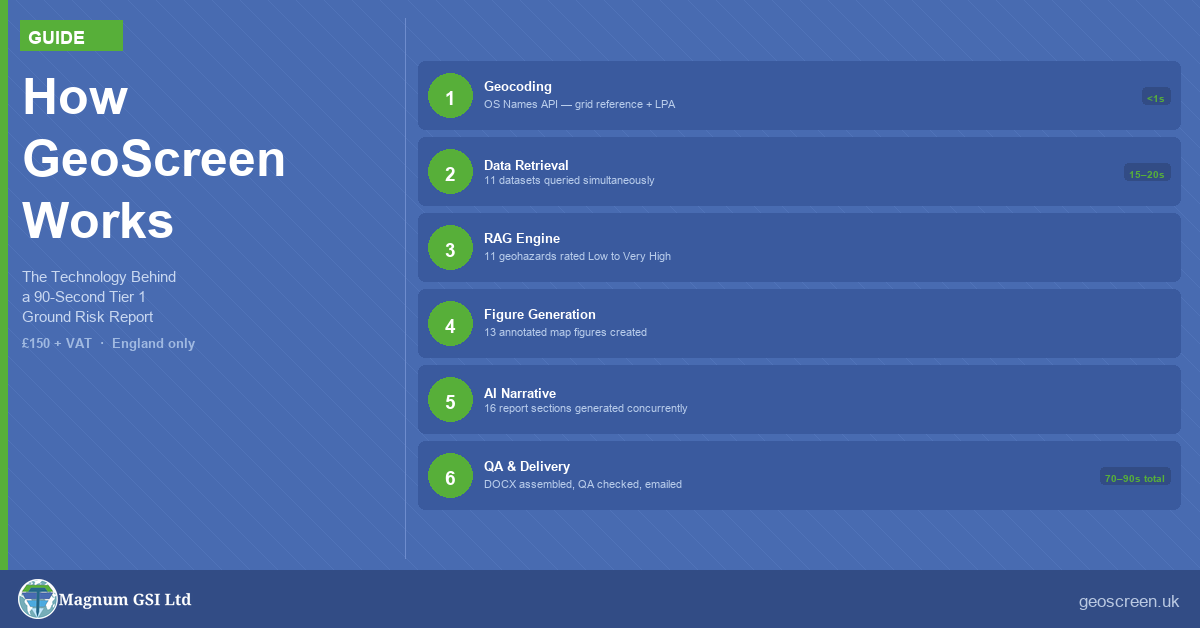
How GeoScreen Works — The Technology Behind a 90-Second Ground Risk Report

How GeoScreen Works — The Technology Behind a 90-Second Ground Risk Report When people hear that GeoScreen delivers a Tier 1 Preliminary Ground Risk Screening Report — a fully automated desk-based assessment — in around 90 seconds, the first question is simple: How? A manually produced desk study typically takes a competent geotechnical engineer one

By |2026-09-22T17:00:19+00:00June 21st, 2026|Design, Featured, Geoscience, Geoscreen, News, Technology|Comments Off on How GeoScreen Works — The Technology Behind a 90-Second Ground Risk Report

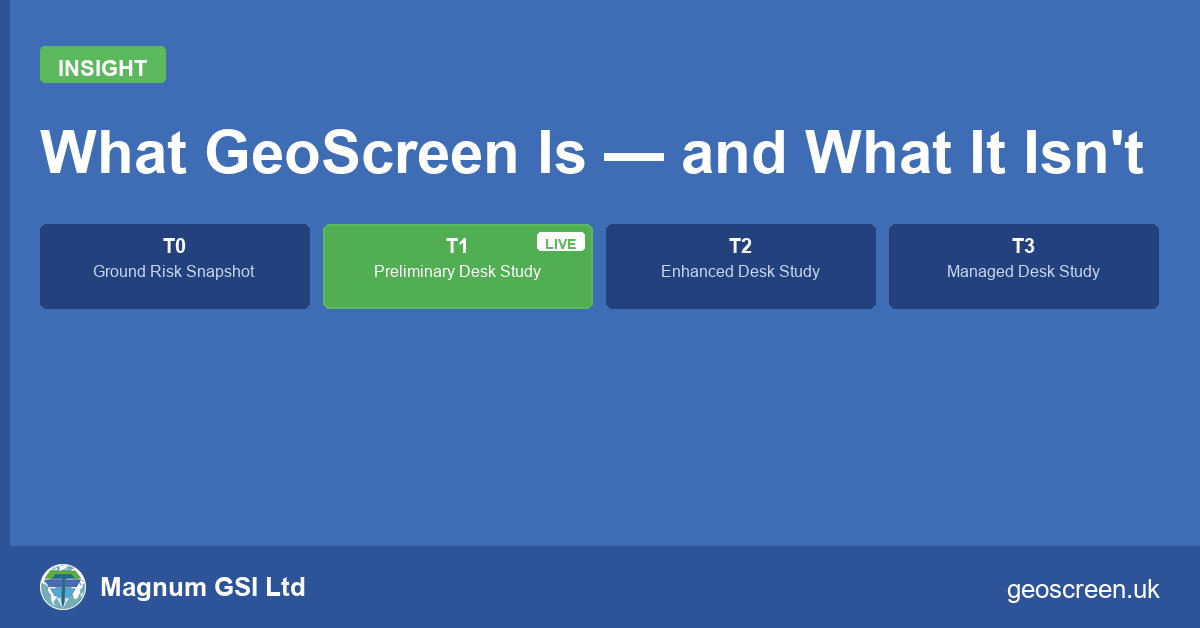
What GeoScreen Is — and What It Isn’t

What GeoScreen Is — and What It Isn't GeoScreen produces a preliminary desk study. It is not a BS 5930:2015-compliant desk study (as clearly noted in the report itself), but a fast, consistent, data-driven starting point — something to have in hand when first considering a site, before committing to the cost of a full

By |2026-09-22T16:56:18+00:00June 18th, 2026|Design, Featured, Geoscience, Geoscreen, News, Technology|Comments Off on What GeoScreen Is — and What It Isn’t

The Problem With Geotechnical Desk Studies — and Why I Built GeoScreen

I've spent nearly twenty years in the ground — boreholes, trial pits, desk studies, risk assessments, planning submissions. And over that time, one issue kept coming up again and again. In construction, ground risk is one of the biggest sources of cost and uncertainty. Get it right early — before land is acquired, before planning

By |2026-09-22T16:49:29+00:00June 17th, 2026|Design, Featured, Geoscience, Geoscreen, News, Technology|Comments Off on The Problem With Geotechnical Desk Studies — and Why I Built GeoScreen
Go to Top