



Compressible ground and shrink-swell clay are two different ways the same clay can cause problems for a
foundation — one’s settlement under load, the other’s volume change with moisture content. They’re
separate failure mechanisms, and until recently GeoScreen rated them from different evidence: shrink-swell
from the bedrock beneath a site, compressible ground only from soft superficial deposits like peat,
alluvium and made ground. Stiff clay bedrock that can genuinely produce both was only ever being checked
for one. That’s changed. The platform now rates both independently on the same site, wherever the geology
supports it.
It came out of looking closely at how the shrink-swell rating actually works. GeoScreen matches a site’s
underlying geology against a list of known shrink-swell formations using standard BGS reference codes, and
checking that logic properly meant going through it formation by formation — London Clay, Gault,
Kimmeridge Clay, Oxford Clay, the usual suspects. That closer look led to two real changes.
First, several of the reference codes in that list turned out not to be real BGS codes at all — close
enough to look plausible, wrong enough never to match anything. Corrected against BGS’s own published
reference, the rating now works properly on Gault, Kimmeridge Clay, Oxford Clay and Lias Group sites that
were quietly returning Low before. London Clay is a slightly different case: at the 1:625,000 scale
GeoScreen screens at, it isn’t mapped as a formation in its own right but sits within the broader Thames
Group, which also contains sand, silt and gravel. That group is now matched at medium susceptibility
rather than high — the honest answer at this resolution, and a reminder that a screening-scale rating is a
prompt to look closer, not a substitute for site-specific data.
Second, the same review showed those stiff clay formations — Gault, Kimmeridge Clay, Oxford Clay, the
Lias Group and the Mercia Mudstone — can independently drive compressible ground too, through settlement
under load rather than moisture-driven movement. That’s a distinct mechanism, not a subset of shrink-swell,
so it’s now rated in its own right on those formations instead of only where soft surface deposits are
mapped.
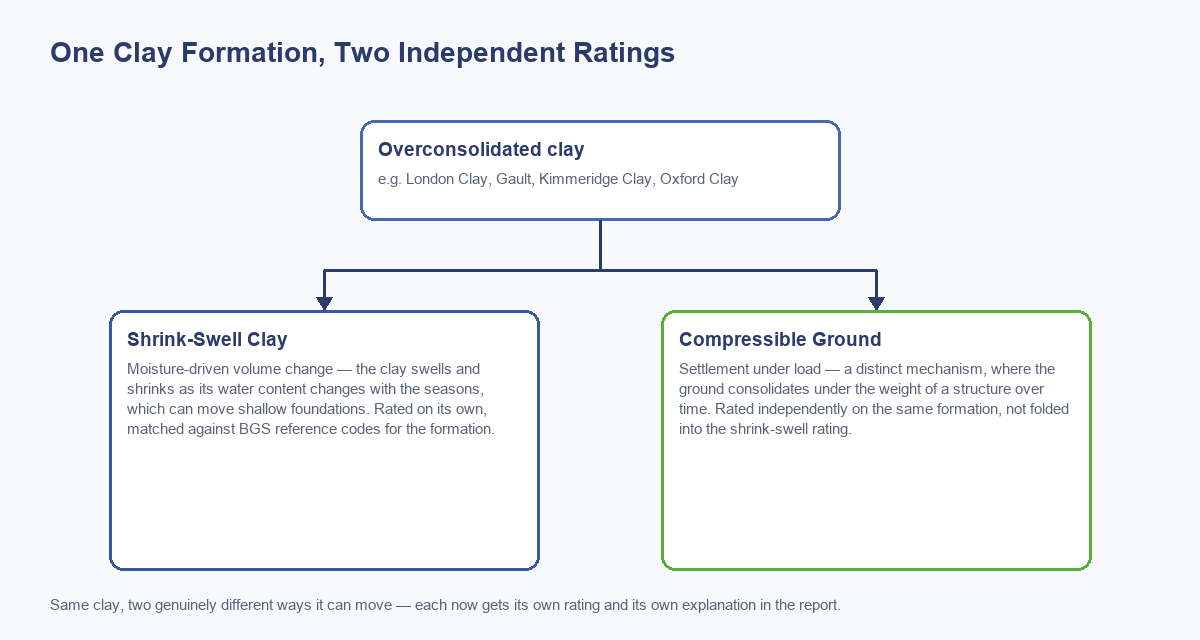
The result is that a single clay formation can now carry two separate ratings, each with its own
explanation in the report, rather than one hazard quietly standing in for both. Both changes went through
the same verification before shipping — a full regeneration of our test set against real API calls, not a
simulation. One real site’s overall rating changed as a direct result — from Low to Medium — because
shrink-swell clay is now correctly recognised as a second material hazard there.
If your site sits on London Clay, Gault, Kimmeridge Clay, Oxford Clay, the Lias Group, or a related
formation, and your report predates 13 August 2026, it’s worth a rerun — both the shrink-swell rating and
the compressible ground rating may come out differently to what you’ve already seen.
